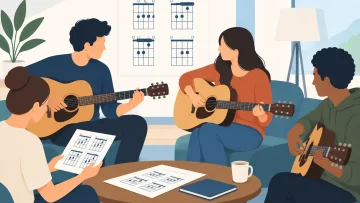
A chord chart can turn a favorite song from something you listen to into something you can play with other people. It may look like a page full of letters, symbols, and mysterious lines at first, but it is really a road map: what chord to play, when the song changes sections, and where everyone needs to land together.
Learning how to read chord charts is one of the fastest ways for beginners, returning players, singers, and future band members to join in. You do not need to read traditional notation to start. You do need a steady beat, a few chord shapes or notes on your instrument, and the willingness to keep going when a change is not perfect yet.
Start With the Song Map
Before playing a single chord, scan the chart from top to bottom. Most charts name the song and list a key, tempo, or style near the beginning. You might see a note such as “Key: G,” “Moderate rock,” or “Capo 2.” These details give you useful context, but the section labels are your first priority.
Common labels include Verse, Chorus, Bridge, Intro, Pre-Chorus, Instrumental, and Outro. Think of them as signs on a road. A verse often changes lyrics while keeping a similar chord pattern. A chorus is the memorable section that returns. A bridge brings contrast before the song heads back home.
A simple chart may look like this:
“`text Verse G D Em C G D C C
Chorus G D Em C G D C D “`
The letters tell you the harmony. The labels tell you where you are in the arrangement. If you are playing with a band, knowing the difference between the second verse and the final chorus matters just as much as knowing a G chord.
Read the Letters as Chord Names
The capital letters A through G are chord roots. If you see C, play a C chord. If you see Am, play A minor. The lowercase “m” changes the chord from major to minor, which usually gives it a darker or more reflective sound.
Charts also use a few common additions:
- 7 means a seventh chord, such as A7 or Dm7.
- sus4 means a suspended chord, such as Dsus4.
- maj7 means major seventh, such as Cmaj7.
- add9 adds a color note, such as Gadd9.
Do not let a long chord name stop you. Read it in layers. For Fmaj7, start with F, then recognize that “maj7” tells you the specific flavor of the chord. Your teacher can show you the best fingering or voicing for your instrument, but the chart is already telling you what sound belongs there.
Guitarists may use open-position shapes, barre chords, or partial chord voicings. Pianists can play a full chord, a simple root-and-third shape, or a more rhythmic pattern. Bass players often begin with the root note. In a band, everyone does not have to play the exact same notes. Everyone does need to support the same chord progression.
Sharps, Flats, and Enharmonic Names
You may see chords like F#, Bb, Eb, or C#. A sharp raises a note by one half step. A flat lowers it by one half step. On a piano, that usually means a neighboring black key, though B to C and E to F are also half steps.
Some notes have two names. F# and Gb are the same pitch, for example. Which name appears on the chart usually depends on the key. At the beginning, focus less on the theory debate and more on finding the right chord reliably.
The Most Important Question: How Long Do I Hold It?
A chord chart does not always spell out rhythm in detail. That is why listening to the song, counting out loud, and watching the spacing on the page all matter.
In many charts, each chord symbol lasts for one measure, or bar. If a song is in 4/4 time, count four steady beats for each measure: “1, 2, 3, 4.” In this progression:
“`text | G | D | Em | C | “`
play G for four beats, D for four beats, Em for four beats, and C for four beats. The vertical lines mark the measures. They are especially helpful when you are learning to change chords at the same time as a drummer, bassist, or another guitarist.
Sometimes a chart places two chords in one measure:
“`text | G D | Em C | “`
In a basic 4/4 feel, G gets beats 1 and 2, while D gets beats 3 and 4. Em and C work the same way in the next bar. Spacing can be a clue, but it is not perfectly standardized. Listen to a recording or ask your instructor when the rhythm is unclear.
If one chord is written several times, change each time you see it unless the chart indicates otherwise. And if there are no bar lines at all, do not guess based only on how wide the spaces look. Find the pulse, count through the section, and use the recording as your guide.
Notice Repeats, Rests, and Road Signs
Charts save space with shorthand. A percent sign (%) often means “repeat the previous measure.” A repeat symbol may send you back to play a section again. You may also see instructions like “Verse x2” or “Chorus x3.” Circle or highlight these moments before rehearsal so they do not surprise you mid-song.
A rest is just as musical as a chord. If a chart says “N.C.”, it means no chord. That could mean the singer is carrying the moment alone, the drummer is setting up a fill, or the whole band needs to leave space before a big entrance. Playing through an N.C. section can make a performance feel crowded, even when every note is technically correct.
Look for words such as stop, hold, break, build, fade, and tag. A “tag” is a short phrase repeated at the end, often to make a final lyric or riff hit harder. These are arrangement directions, not chord names, and they are vital when playing with a group.
Understand Slash Chords Without Overthinking Them
A slash chord looks like D/F# or C/E. The chord before the slash is the main harmony. The note after the slash is the bass note.
For D/F#, a guitarist or pianist plays some version of D major, while the bass note should be F#. On guitar, this may mean changing the lowest note in your chord shape. On piano, your left hand might play F# while your right hand plays D major. If you are a new player and cannot make the full shape yet, play the main D chord first, then work with your teacher on adding the bass note. The trade-off is that the harmony will be close, but the smooth bass movement may be missing.
Capos Change the Sound, Not the Chart Shapes
Guitar charts sometimes say “Capo 2” or “Capo 4.” The chord names shown often tell you the shapes to play, not the concert-pitch chords you are hearing.
For example, if a chart says Capo 2 and shows G, you play a G shape with the capo on the second fret. The band may actually be sounding in A. This is normal, but it requires communication. If you are rehearsing with a keyboard player, bassist, or horn player, make sure everyone knows whether the chart uses capo shapes or concert chords.
Make the Chart Easier to Follow in Real Time
A chart is meant to be used, not admired. Give yourself permission to mark it up. Write in the number of repeats, circle difficult changes, draw a line before a big stop, and make the chorus label bold enough to spot at a glance. For young musicians, color-coding sections can be useful. For adults returning to music, a larger print size can make rehearsal much less stressful.
When you practice, do not begin by trying to play every fancy strum, fill, or inversion. First, clap the beat and say the chord names in time. Next, play one strum or one note per measure. Then add a steady rhythm. This builds the skill that matters most in an ensemble: recovering and staying with the song.
At Music Academy Asheville, students often discover that chord charts become much more meaningful once they are playing alongside other musicians. A missed chord is rarely the end of the song. Keep counting, listen for the next landmark, and come back in at the next chord you recognize. That is how real bands keep moving.
A Quick Way to Practice Any New Chart
Choose a simple song with three or four familiar chords. Listen once without playing and identify the verse and chorus. Then tap four steady beats for every measure as you point to each chord. Play through again using the easiest version of every chord you know. Finally, try it with the recording and pay attention to where the changes actually happen.
As your skills grow, charts can lead you into blues progressions, classic rock hooks, Americana ballads, punk songs, jazzier seventh chords, and original music. The symbols may become more detailed, but the core job stays the same: follow the form, feel the beat, and make the next musical choice with the people around you.
The best chord chart readers are not the players who never make a mistake. They are the players who can listen, count, find their place, and help the music keep going.