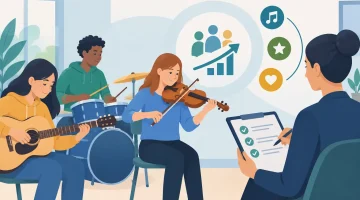
A great youth music program evaluation does not begin and end with a recital score or a checklist of songs completed. Parents want to know whether their child is growing as a musician, but they also want to see confidence, focus, friendships, and excitement carry over from the lesson room into everyday life. For young musicians, progress is rarely one straight line. It might show up when a quiet singer finally takes the microphone, when a new drummer holds the groove for a whole song, or when a student learns how to recover after missing a chord.
At Music Academy Asheville, we believe music is for everyone, from first-time beginners to experienced players ready for the stage. That means evaluation should be encouraging, specific, and connected to each student’s goals, whether those goals involve learning piano fundamentals, joining a band, writing songs, or playing a local gig.
What a Youth Music Program Evaluation Should Measure
Technical skill matters. Students need to build control, musical vocabulary, and healthy habits on their instrument. Yet technical skill is only one part of a meaningful evaluation. A young guitarist who has learned three new chord shapes has made progress. A guitarist who can listen to the drummer, keep time, and confidently play those chords with a band has made a different, equally valuable kind of progress.
The best evaluations look at both individual musicianship and the ability to make music with others. This is especially true in ensemble programs, where students learn that a great performance is not about being the loudest player in the room. It is about listening, responding, preparing, and supporting the song.
A useful evaluation often considers four connected areas: musical skills, practice habits, personal confidence, and collaboration. Looking at all four gives families a clearer picture than grades alone can provide.
Musical skill and understanding
Skill development will look different for every instrument and age group. A beginning piano student may be learning steady rhythm, note recognition, and hand position. A developing vocalist may be improving breath support, pitch matching, and lyric delivery. A more advanced bassist may be working on tone, groove, and navigating chord changes by ear.
Rather than asking only, “How many songs has my child learned?” ask whether they understand what they are playing. Can they keep a steady beat? Can they hear when something is out of tune? Can they start again after a mistake without stopping the entire song? Those are practical signs that musical independence is taking root.
Practice habits that fit real family life
Practice is part of learning, but it should not become a nightly argument. A quality youth program helps students develop realistic routines based on their age, instrument, schedule, and motivation. Ten focused minutes can be more productive than forty distracted ones.
Evaluation should identify what is working and what needs adjusting. Some students need a simple weekly goal, such as playing one section slowly with a metronome. Others benefit from choosing a favorite song as a reward after working on technique. A teacher can help a family distinguish between a student who needs more structure and one who may need a fresh musical challenge.
Confidence, resilience, and ownership
Music asks young people to be visible. They may have to sing in front of classmates, play a solo, take feedback, or perform when they feel nervous. These moments can be uncomfortable, but they are also where confidence grows.
A thoughtful evaluation notices the small wins. Maybe a student now raises their hand to suggest a song. Maybe they are willing to try again after a rough rehearsal. Maybe they can explain what they want to improve next week. When students begin setting their own musical goals, they are no longer simply attending lessons. They are becoming musicians.
Collaboration and performance readiness
Band programs offer a powerful test of progress because the music must work in real time. Students learn to count in, follow a form, listen for transitions, and make space for other players. They also learn that preparation affects the whole group.
Performance readiness is not just about playing every note perfectly. It includes arriving prepared, managing nerves, communicating with bandmates, and staying engaged when something unexpected happens. A student who keeps playing through a missed note and finds the next section has demonstrated real stage skill.
How Families Can Read Evaluation Feedback
The most helpful feedback is clear enough to guide the next step. “Great job” feels good, but “Your rhythm stayed steady through the chorus, so let’s work on cleaner chord changes in the verse” tells a student exactly what to celebrate and what to practice.
When you receive feedback, look for a balance of strengths and priorities. Every student deserves to hear what they are doing well. At the same time, growth depends on having a manageable target. One or two focused goals are usually more effective than a long list of corrections.
It also helps to consider the student’s original reason for enrolling. Some young musicians want to prepare for auditions. Others want a creative after-school activity, a chance to make friends, or a place where they can play the music they love. A strong program can support ambitious skill-building and joyful participation, but the emphasis may shift from student to student.
For example, a child who is brand new to drums may not be ready for complex fills, but they may be making excellent progress if they can play a dependable beat with a group. A teen with several years of private instruction may need more advanced repertoire or performance challenges to stay engaged. Evaluation should meet students where they are, then help them move forward.
Questions That Lead to Better Conversations
Parents do not need to be music experts to support a young musician. A few open-ended questions can reveal more than asking, “Did you practice?” Try asking what song they are most excited to play, what part feels easier than it did last month, or what they want their audience to feel at a performance.
These questions invite students to reflect without making music feel like another report card. They also give instructors useful insight. If a student loves punk, blues, Americana, hard rock, or pop, that musical interest can become a bridge to technique and theory. From Metal to Mozart, students work harder when they can hear themselves in the material.
If feedback suggests a challenge, keep the conversation calm and curious. A plateau does not mean a student lacks talent. It may mean they need a smaller practice goal, more time with a difficult skill, a different song choice, or more opportunities to play with peers. Music learning has seasons. Consistency and encouragement matter more than quick comparisons.
Evaluation Should Shape the Next Musical Step
The purpose of evaluation is not to label students as naturally gifted or not gifted. It is to make the next step visible. That next step might be refining a scale, preparing for a recital, joining a Rock Academy band, trying a new instrument, or learning to perform with more confidence.
Programs should use feedback to adapt instruction, too. If a group struggles with transitions, rehearsals may need more work on listening and cueing. If students are technically capable but hesitant onstage, they may benefit from low-pressure performance opportunities before a bigger show. If a student is ready for more challenge, a teacher can introduce stronger repertoire, improvisation, songwriting, or leadership within an ensemble.
There is a trade-off here. Constant measurement can drain the joy out of music, while no feedback can leave students unsure of how to improve. The right approach is regular, human, and goal-oriented. It celebrates effort without pretending every attempt is finished, and it gives young musicians room to experiment, make mistakes, and keep going.
The best sign of a successful program may be the moment a student walks out of rehearsal still humming the song, talking about their bandmates, and already planning what to try next time. That is progress worth noticing.